
Home » News (Page 4)
Category Archives: News
Download ASDSW-SDCS 2016-2018 General Report:

Projects To Benefit Maguindanao Villages
KORONADAL CITY (PIA) – More villages in Upi, Maguindanao, are set to benefit from several projects that could help alleviate poverty, and foster peace in the area.
Upi local government officials said these projects include access to potable water, day-care centers, and livelihood projects.
Noraida Chio, team leader of the A Single Drop of Safe Water (ASDSW) Cotabato office, announced recently that Upi town has been selected as a pilot site for a water sanitation and hygiene project to be funded by the United Nations Children’s Fund (UNICEF), in partnership with the Maguindanao provincial and municipal governments.
Under the project, the clustered villages of Rempes, Ranao Pilayan, Bayabas, Kibleg, and Mirab, as well as Barangay Tinungkaan, will have access to clean sources of water – primarily to prevent outbreaks of water-borne diseases.
Besides Upi, the municipalities of Parang, and Sultan sa Barongis have also been included as pilot areas.
Chio explained that these villages were selected based on several criteria, including existence of governance, peace and order situation, accessibility, and presence of water-borne diseases based on previous assessment of local water sources.
Chio emphasized that the program believes that provision of clean and potable water in underprivileged communities could help boost efforts to achieve long-lasting peace.
Meanwhile, five other villages in Upi town will also have their own day-care centers, courtesy of the Department of Social Welfare and Development.
Social welfare officer III Marilou Diestro disclosed that the day-care centers will be built in the villages of Blensong, Kibleg, Sefegefen, Bugabungan, and Borongotan within 45 days.
Diestro said each day-care center that will be constructed in partnership with the Philippine Army’s Engineering Brigade based in Awang, Datu Odin Sinsuat, costs P617,000.
Last May 16, a groundbreaking ceremony was held in Barangay Kibleg to signal the start of the construction of the facilities, which are seen to be of great help, especially in honing the minds of pre-school children in the identified areas.
Delivery of construction materials have already began for the other day-care centers.
Last May 17, a village assembly was held in Barangay Sefegefen to announce that a grant amounting to P1.5 million have been awarded to the municipality.
As this developed, municipal engineer Gerardo Cariño said the fund under the Municipal Block Grant through the ARMM Social Fund Project was given to the village as a result of the positive result in the monitoring of previous projects granted to them, and for the cooperation the village had shown in the implementation of their projects.
Cariño said the funding was part of a government loan from the World Bank in cooperation with the Japan International Cooperation Agency (JICA).
The fund and the projects, the municipal official said, will be managed by the Centro Sefegefen Farmers Association.
Survey on what specific projects this fund will be spent on is still being finalized, he added.
The village-wide assembly was also attended by Diestro, municipal local government operations officer Cicellia Pelobillo, municipal facilitator Cheruben Real, 4Ps municipal link Maureen Obina, and village officials led by Dominador Moendem.
source: http://www.mb.com.ph/articles/360099/projects-to-benefit-maguindanao-villages#.T73MdRn4HZI.facebook

ASDSW Speaks at UNDP Event “Transformative Leadership in Public Administration and Innovation in Governance”
Paper for UNDP Conference in Dar Es Salaam, Tanzania June 20-23 2011 “Transformative Leadership in Public Adminsitration
HR and Partnership Paper Kevin Lee Rev 2
ASDSW presented this paper in the workshop for “Engaging Citizens and Civil Society Organizations to Promote Effectiveness, Accountability and Transparency in Reconstruction and Recovery Strategies after Natural Disasters”. Thanks to Ben Smilowitz from Disaster Accountability Project (DAP) for linking us to this conference and being a voice for holding organizations accountable for their actions in Humanitarian Response.
March 2011 Newsletter. News and Views from the Field
Click here to view Newsletter
An update on whats going on with ASDSW. Includes message from the Executive Director, stories from the field and update ongoing projects .

ASDSW wins the The Katherine M. Swanson Equality Award Laureate | 2010 Tech Awards
About The Tech Awards
The Tech Awards is an international awards program that honors innovators from around the world who are applying technology to benefit humanity.
Each year, candidates are nominated and then invited to submit applications. Individuals, for-profit companies, and not-for-profit organizations are eligible. International panels of judges review the applications and annually select 15 Laureates. Awards are presented in five categories: Environment, Economic Development, Education, Equality, and Health. Three Laureates in each category are honored and one Laureate per category receives $50,000. Laureates are honored at an annual Gala event and inducted into The Tech Awards Network (TAN). The TAN extends the award program from an annual event to a year round program. The goal of the TAN is to create opportunities for learning, networking, and exposure to assist the Laureates in furthering their work.
Hand Pump and Sanitation Facilities Manual – Draft
The Promised Land
by Mary Jun Decafe – Nicolasora
This is the river where the community fetch water prior 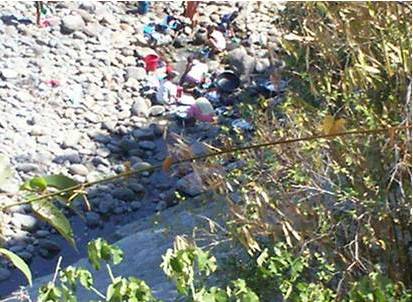
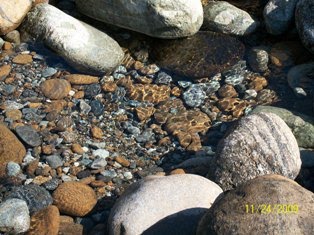
to the rehabilitation of their water system. This clear water
was dug on the river bank and is used for drinking.
The team’s mode of transportation from and to Iba, Zambales for an hour bumpy ride.

The iBoP Research Team, Mr. Alejandro Pongyan and Ms. Luisa Lee during their data gathering in Lupang Pangako.
Ms. Lee is posing with the women members of the Aeta Belbel Multi – Purpose Cooperative near their non functioning water system. The same women were members of the ad hoc women’s group that emerged during the WAter, Sanitation and Hygiene (WASH) orientation conducted by ASDSW in December, 2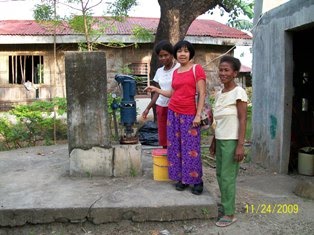 009. The WASH orientation was conducted as a response to the data gathered by the research team which told of numbers of death due to water – borne diseases. Other outputs related to this orientation were the acquisition of some community members of a 20L – water container and hyposol (chlorine – based disinfectant). Members of the women’s group were also tasked to advocate for the installation of a modified arborloo latrine per household in which by March of this year a total of 48 latrines were
 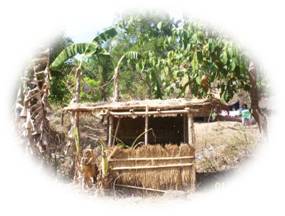 installed and from these, 30 were regularly used.
Because water – borne diseases were not just brought about by poor sanitation and hygiene practices but also because of the lack of clean and safe water source, another visit was conducted. This visit resulted to a signed agreement among other stakeholders – Office of the Department of Public Works and Highways – Iba (DPWH – IBA), Office of the Provincial Health (PHO), World Vision – Zambales, A Single Drop for Safe Water (ASDSW) and the community itself.
From this agreement, the community was able to access 157 more of 20L – water containers and hyposols from the Provincial Health Office under the leadership of Dr. Raulin A. Dadural and finally, clean and safe water from the DPWH, ASDSW and World Vision – Zambales under the leadership of Ms. Zenia Capiral and unwavering efforts of Ms. Vicky Layugan.
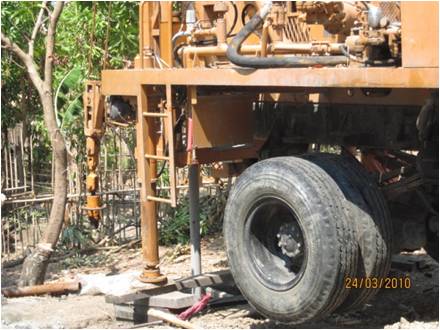
During the drilling in May. Drilling machine courtesy of the DPWH – Iba under the leadership of Engineer Herkules Manglicmot and Engineer Delfin Esposo who personally took charge in fulfilling their part of the agreement and more.
These are the facilities of the new water system of the Aeta Community in Lupang Pangako.

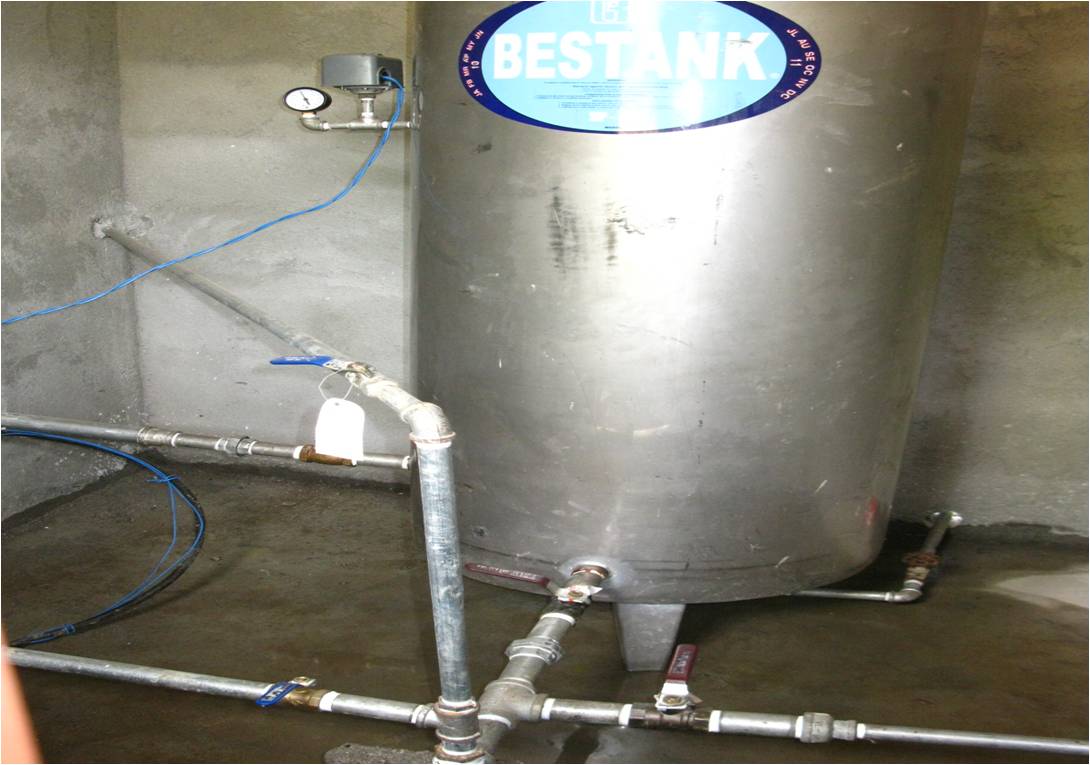
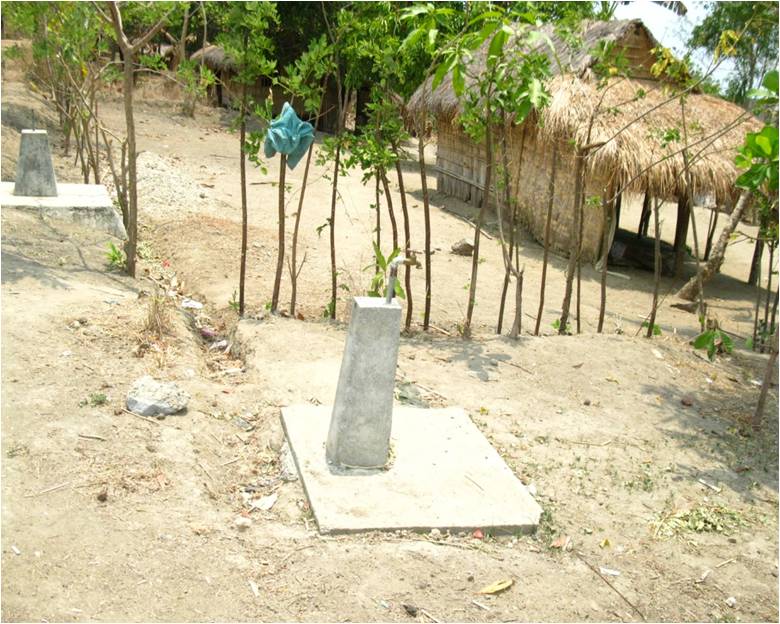 There are 4 tapstands in all.
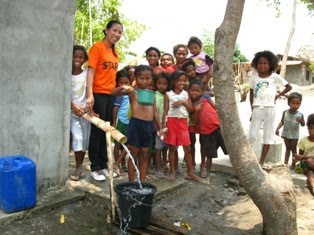
Finally, safe and clean water for Lupang Pangako!
Thru iBoP ASDSW has returned and addressed concerns of the Aeta community in Lupang Pangako.
The Promised Land
This is the river where the community fetch water prior
to the rehabilitation of their water system. This clear water
was dug on the river bank and is used for drinking.
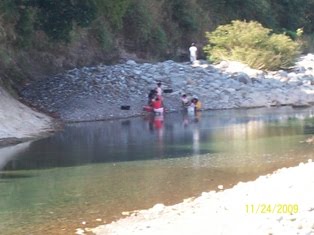
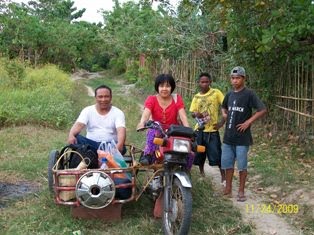
The team’s mode of transportation from and to Iba, Zambales for an hour bumpy ride.
The iBoP Research Team, Mr. Alejandro Pongyan and Ms. Luisa Lee during their data gathering in Lupang Pangako.
Ms. Lee is posing with the women members of the Aeta Belbel Multi – Purpose Cooperative near their non functioning water system. The same women were members of the ad hoc women’s group that emerged during the WAter, Sanitation and Hygiene (WASH) orientation conducted by ASDSW in December, 2009. The WASH orientation was conducted as a response to the data gathered by the research team which told of numbers of death due to water – borne diseases. . Other outputs related to this orientation were the acquisition of some community members of a 20L – water container and hyposol (chlorine – based disinfectant). Members of the women’s group were also tasked to advocate for the installation of a modified arborloo latrine per household in which by March of this year a total of 48 latrines were installed and from these, 30 were regularly used.
Because water – borne diseases were not just brought about by poor sanitation and hygiene practices but also because of the lack of clean and safe water source, another visit was conducted. This visit resulted to a signed agreement among other stakeholders – Office of the Department of Public Works and Highways – Iba (DPWH – IBA), Office of the Provincial Health (PHO), World Vision – Zambales, A Single Drop for Safe Water (ASDSW) and the community itself.
From this agreement, the community was able to access 157 more of 20L – water containers and hyposols from the Provincial Health Office under the leadership of Dr. Raulin A. Dadural and finally, clean and safe water from the DPWH, ASDSW and World Vision – Zambales under the leadership of Ms. Zenia Capiral and unwavering efforts of Ms. Vicky Layugan.
During the drilling in May. Drilling machine courtesy of the DPWH – Iba under the leadership of Engineer Herkules Manglicmot and Engineer Delfin Esposo who personally took charge in fulfilling their part of the agreement and more.
These are the facilities of the new water system of the Aeta Community in Lupang Pangako.
There are 4 tapstands in all.
Finally, safe and clean water for Lupang Pangako!
Thru iBoP ASDSW has returned and addressed concerns of the Aeta community in Lupang Pangako.
Natural and Manmade Disasters in the Philippines
September 26th 2009, Typhoon Ondoy (Ketsana) made landfall in Luzon dumping over 12” of rain in 6 hrs on Manila and other parts of the National Capital Region. This caused massive urban flooding, 280+ deaths, destroyed homes and shelters of millions of people. Five days later, typhoon Pepeng (Parma) made landfall in northern Luzon, devastating agriculture in the Cagayan Valley. It then hung around the north west coast making landfall two more times and dumping up to 6’of water in some areas, causing massive and deadly landslides resulting in another 380+ people losing their lives. Dams in Luzon released water causing flash floods and many major cities are still flooded as government and relief agencies struggle to cope with the massive destruction. Currently there are approximately 500,000 people living in Evacuation Centers in Luzon and millions more piecing together their lives and living in areas that are still flooded. This is actually an annual occurrence affecting many areas of the Philippines. Typhoons in 2006 hit Manila and Bicol causing massive damage and loss of life.
It was absolutely inspiring to see the heroic efforts of those who helped in the immediate response to these disasters. Witnessing the resiliency and resourcefulness of people helping others, the outpouring of donations of money, food and clothing are a reflection of the generous human spirit. However, in the midst of all the generosity and relief efforts, astounding inefficiencies and lack of coordination can actually have a large negative impact on the rebuilding process. After the Bicol typhoons there was a call by many relief and government agencies to coordinate relief efforts and work together to prepare communities for these situations. Though there have been general meetings to mobilize local water and sanitation organizations and international relief agencies to develop protocols, emergency preparation efforts have been discussed, ideas proposed, but sadly, have not been coordinated nor implemented.
In general, there are four phases in addressing emergencies: preparedness, response, relief and rehabilitation. Each phase must be equally coordinated and strengthened in order to minimize risk and loss of life. In the Philippines, we are hard-pressed for strong and efficient protocols to roll out any of these phases for a few reasons.
First, the Philippines is the most disaster-prone region in all of Southeast Asia. Each year, typhoons and monsoons cause landslides, flooding and other devastating effects on communities all over the country. Also, with ongoing conflict in Mindanao, manmade disasters have caused major destruction in areas creating large populations of internally displaced people (IDPs). With the frequency of very different kinds of disasters, it has been difficult for communities as well as aid NGOs (non-governmental organizations) to try and implement effective and appropriate plans for preparedness and response.
Second, the inefficiencies of the stakeholders have been a deterrent in implementing emergency preparedness and disaster response protocols. Dealing with a number of large International NGOs (INGOs) and under-resourced government agencies with different strategies, techniques and target areas has made it difficult to organize any kind of coordinated efforts such as communications, info gathering and sharing, technology implementation and supply availabilities and distribution. To make matters worse, without these protocols in place, local government units have to wait for the Federal government to declare their areas disaster regions in need of federal support. Proper reporting from the field with the necessary information to make the declaration is crucial for timely and appropriate actions to be implemented.
Third, badly designed and implemented technologies such as toilets or wells have created adverse short term and long term effects on relief and rehabilitation. Technology implementation is often contracted out to foreign contractors with little experience in the country and focused only on immediate implementation with short term relief.
Further, we’ve found in working with these larger agencies who specialize in humanitarian relief that they have little or no basic documentation or manuals on how to build these facilities. There is very little quality control or follow-up and the failure rate is high. Although ASDSW is not a relief agency, we are in the process of developing materials along with these agencies so that response can be quicker and much more effective.
Lastly, because of the frequency of these disasters in the same general areas, local people have built a sense of resilience as it is not uncommon for many communities to live through the same tragedy more often than in other areas. Trying to mobilize communities and implement preparedness protocols in communities who have endured such disasters as frequent as many have, there is a sense of futility that overrides need for organizing.
With these recent typhoons, our projects in Luzon have been affected. One of our partner communities in Rizal Province located on an island in the middle of a river have been flooded out. Because of the sheer magnitude of the task ahead, ASDSW has two engineers working with to Oxfam to develop and implement better water and sanitation technologies and techniques. For example, one of our engineers has designed an innovative toilet on stilts or “loo with a view”, and is determined to develop a floating toilet (probably with a poop deck). We are also working towards better design for wells and rehabilitating existing wells as another way to ensure long term use in a case where the evacuation center must be used again in future disasters.
Regardless of the fact that some of the most devastating typhoons in our nation’s history have affected communities all over the Philippines in the last three years, this outcry has reached international audiences because it hit Manila, our country’s capitol. Pictures of flood devastated areas in the city prompted phone calls from celebrities pleading for help, which provided momentum for the mobilization of resources from within and outside the country. If Typhoon Ondoy had not hit Manila perhaps these efforts would have been severely under-resourced and the outcry over this tragedy may have been minimal as we’ve seen happen so often in the past.
As tragic as these natural disasters are, most people reading this, as well as most Filipinos that do not reside in the Autonomous Region for Muslim Mindanao (ARMM) do not realize that one of the worst ongoing disasters in the country, if not the world is occurring 1,600 km south of Manila. There has been ongoing conflict in this region for decades between the government and the groups Muslim Islamic Liberation Front (MILF) and Muslim National Liberation Front (MNLF). Peace treaties have been brokered and broken for years but in August 2008, peace talks between the government and MILF broke down. As a result, the numbers of people displaced has varied from 280,000 up to 1,000,000. Currently, this number is now estimated at 330,000 to 400,000 displaced people and is expected to remain until after the election in May 2010. Ongoing efforts by relief agencies have been hindered by the failure to cooperate from both sides as well as a lack of resources available or offered in the area. The withholding of food aid is occurring along with many human rights abuses violated on both the government and the MILF. This situation is worsening rapidly as dwindling resources already stretched thin in the region are now being diverted to Luzon for the typhoon relief.
Throughout 2008 and 2009 ASDSW worked hand in hand with seven Civil Society Organizations (CSOs), Peoples Organizations (PO) and Local Government Units (LGU) to build the Water and Sanitation capacity of thirty-one municipalities throughout ARMM. Reports from our staff noted nearby shelling while meeting with POs and LGUs; traveling to worksites through multiple check points; the killing of one of our CSO partners; trainings conducted while armed police and military looked on. Despite the ongoing conflict, ASDSW staff and our partners demonstrated tremendous dedication and kept faithful the belief we were doing the right thing.
As a testament to their hard work and relentless commitment, the culmination of over fifty small projects in these areas have implemented water, sanitation and hygiene (WASH) projects which have impacted over 5,000 families. To further ensure sustainability, we have established mechanisms in all thirty-one municipalities to help them design, plan and implement WASH projects. Nearly half are now functional and proactively implementing their plans.
ASDSW is now working with OXFAM and two other local CSOs to implement a better WASH strategy for Evacuation Centers and Home Based IDPs. This also includes the development of handbooks and designs to overcome the issues that are facing already installed interventions, e.g. sanitation, water treatment, wells. Because of the deep need in ARMM, ASDSW has opened a satellite office in Cotabato City, Mindanao.
As climate change impacts become more frequent and devastating, the development of disaster management protocols is crucial in mitigating risk. Investment to engage and educate the communities in appropriate preparedness, response and relief programs can make the rehabilitation and rebuilding of their own communities less devastating. ASDSW works with communities to build their resilience and better equip them for the impending disasters, which if the last three years proves, can be an annual expectation.
Kevin Lee and Gemma Bulos
Featured Videos
WaSH DRR Program in Capiz

Sanitation Marketing


Download ASDSW's 2011 Annual Report:


